Fluid dynamics, in its full Navier-Stokes generality, is computationally merciless. To simulate the turbulent wake of a cylinder, or the swirling film of water across the surface of an arbitrary 3D object, a conventional solver must discretize not only the surface but the entire surrounding volume—a three-dimensional grid whose resolution requirements scale catastrophically with the complexity of the phenomena being captured. For the needs of visual effects, interactive design tools, and real-time physics, this cost is often prohibitive.
The alternative that Marcel Padilla explores in his research *Point Vortex Dynamics on Closed Surfaces* is old in its origins—dating to Kirchhoff and the nineteenth-century theory of ideal fluids—and new in its application. The point vortex model reduces the full, continuous vorticity field of a fluid to a finite collection of singular points. Instead of tracking velocity at every location in a volume, the model tracks only the *whirls* themselves: concentrated regions of rotation that induce motion throughout the surrounding fluid through the Biot-Savart-like interactions their presence generates. What is sacrificed in physical granularity is recovered in speed, topological clarity, and a certain mathematical elegance.
"Vorticity-based fluid simulations excel in computational speed by focusing on the most dynamic regions of motion: the areas where the fluid twists the hardest. Everything else is consequence."
The Conformal Bridge
The extension of point vortex dynamics from flat Euclidean planes to the curved, arbitrary surfaces of computational geometry is the central contribution of Padilla's work. Vortex dynamics on a sphere are well understood; the same cannot be said for a mesh like the Stanford Bunny, whose irregular curvature creates a non-uniform potential landscape that distorts the vortex interactions in ways that flat-plane formulas cannot capture.
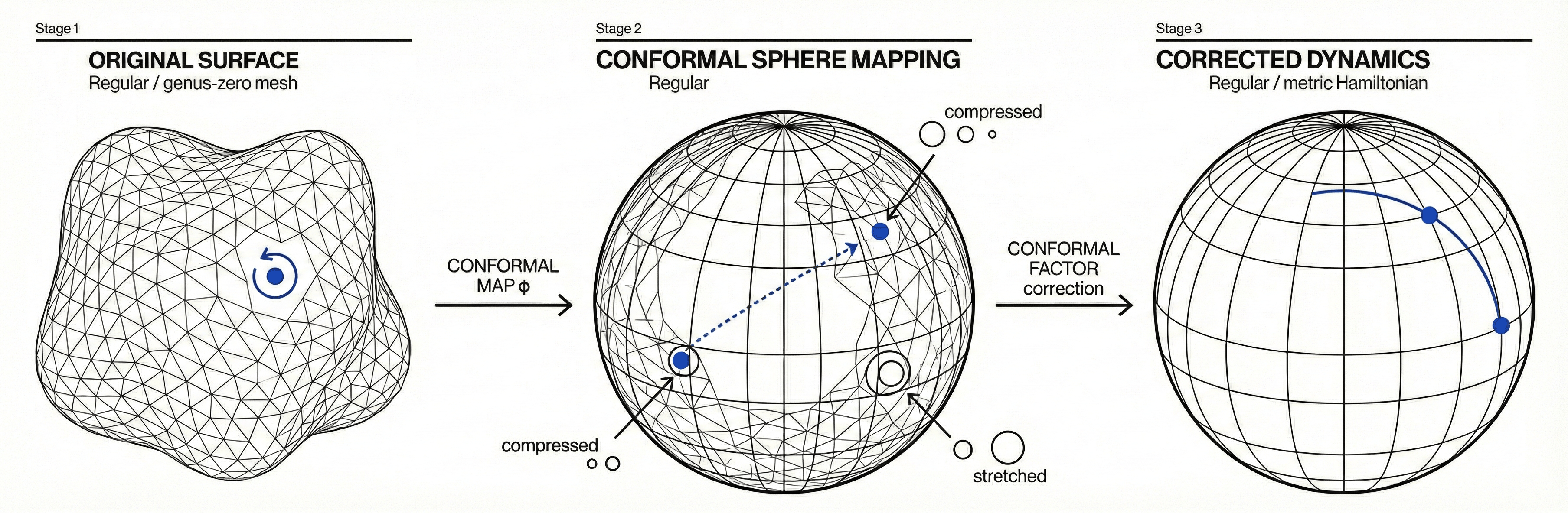
Padilla's approach relies on conformal mappings—the mathematical operation of "flattening" a genus-zero surface onto a unit sphere
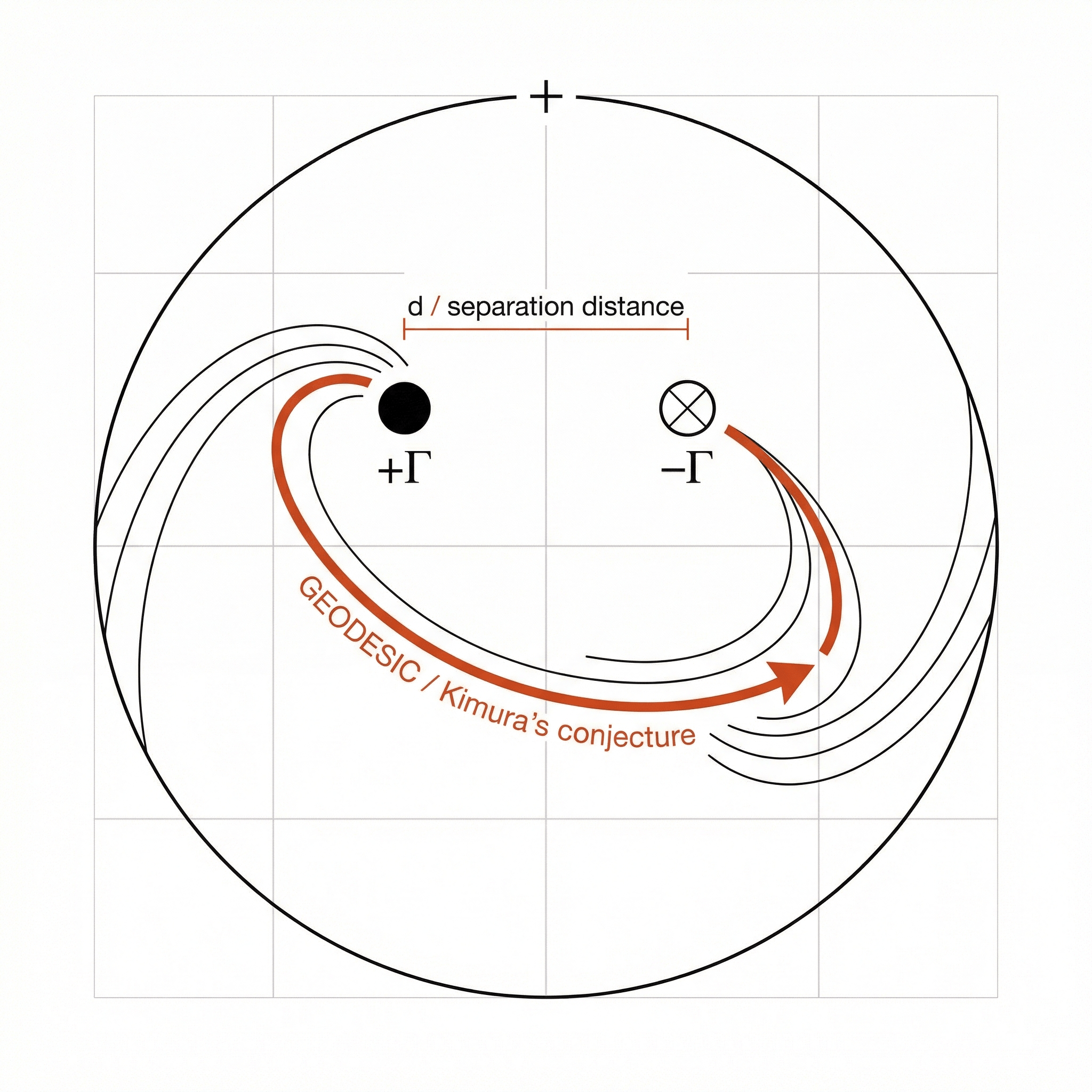
The validation is elegant. On these complex surfaces, a vortex pair of equal and opposite strength—the simplest possible configuration—travels along a geodesic, exactly as Kimura's classical conjecture predicts
Implications for Surface Animation
For the computational designer, the practical value of this approach lies in its fundamentally surface-native character. A conventional fluid simulator requires a volumetric grid surrounding the object; the point vortex model lives entirely on the surface skin, requiring no enclosing volume. Swirling flows, turbulent streaks, path-based animations—all can be generated on arbitrary geometry as intrinsic surface phenomena rather than projections from a surrounding medium.
The model is not a replacement for Navier-Stokes when physical accuracy is paramount. It is something more specific: a tool for situations where the soul of the fluid—its rotation, its circulation, its topological structure—matters more than the precise velocity at any given point. For interactive simulation, procedural animation, and rapid iteration on fluid-inspired surface behaviors, Padilla's framework offers a pathway that is both physically principled and computationally forgiving.