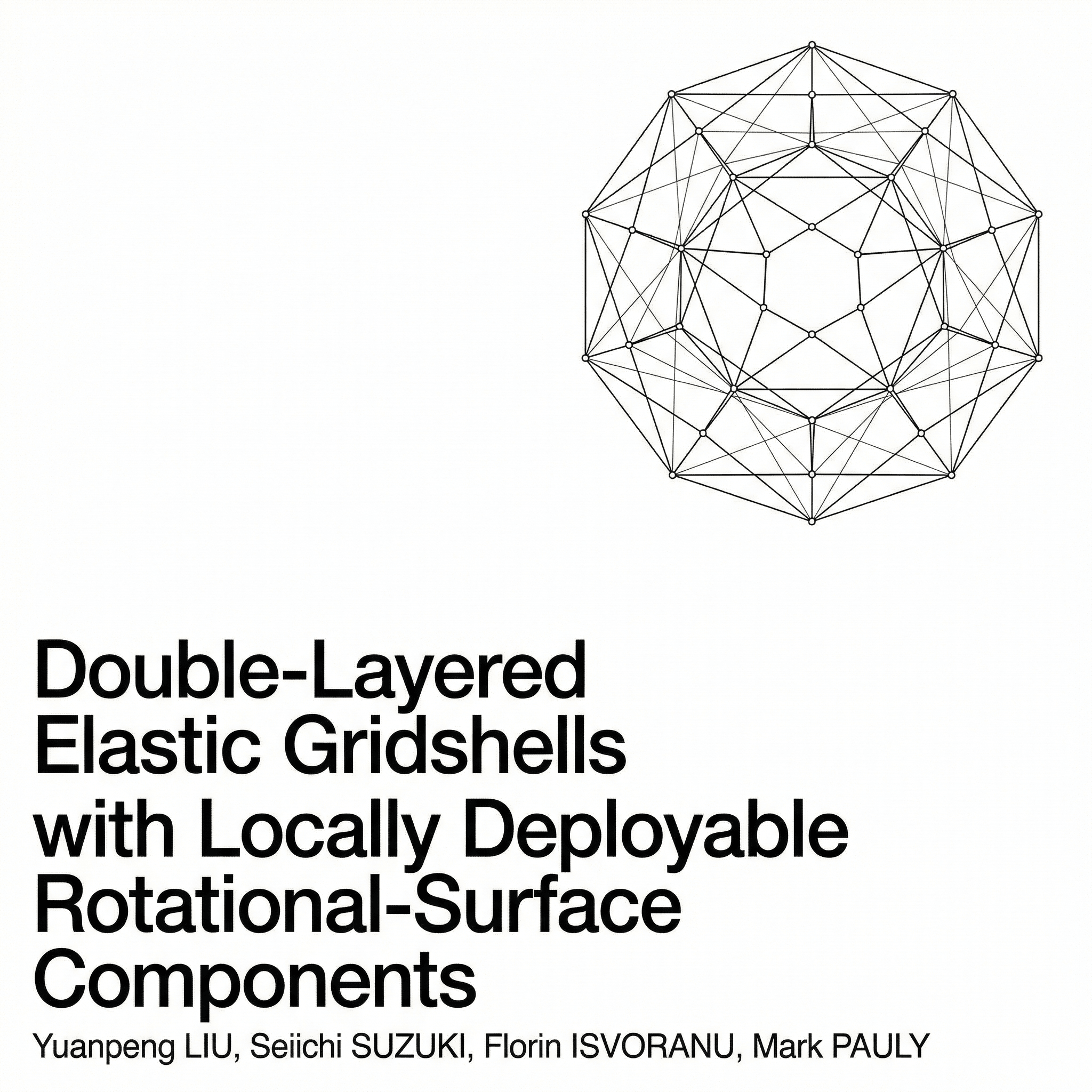
Picture the component before it is deployed: a compact bundle of laminated strips, held in a near-cylindrical form, about the size and heft of a fireworks tube. Nothing about it announces its ambition. Then it is released—hinges unlocking, lamellae splaying apart—and in seconds it has expanded into a double-curved, double-layered surface of revolution, a flowering of structural geometry that immediately locks into its deployed shape without any external locking mechanism. Connect enough of these, and you have a doubly-curved shell.
This is the constructive logic at the heart of a recent paper by Yuanpeng Liu, Seiichi Suzuki, Florin Isvoranu, and Mark Pauly, which introduces a class of bending-active gridshells assembled from what the team calls locally deployable components. The key word here is *locally*. Conventional elastic gridshells typically demand a global deployment strategy: an entire flat mesh is assembled on the ground and raised, or stressed, into its final curved form in a single operation. This approach has proven both spectacular and logistically demanding. Liu et al. propose a different distribution of complexity—one that is resolved at the component level, making each prefabricated module individually deployable, transportable compactly, and snapped into place on-site without scaffolding.
The Geometry Inside the Bundle
Each component is fabricated from straight elastic lamellae joined by a non-uniform linkage. The genius of its deployability lies in a precise geometric constraint: its ribbons are traced as symmetric geodesic lines on an underlying surface of revolution. Geodesics, being the straightest possible paths on a curved surface, have zero geodesic curvature. This means the thin ribbons bend easily out of the surface plane but resist bending sideways along it, a property that is essential for controlled deformation. Furthermore, the strict bilateral symmetry of the ribbon layout with respect to the surface's meridians constrains the complex bundle's motion to a single, predictable degree of freedom. This is what allows it to expand and contract so reliably. The surface of revolution thus becomes a kind of hidden structural template: invisible in the finished shell, but responsible for its foldability.
"This strategy avoids the complexities of global deployment while retaining the benefits of deployability at the local level—enabling the formation of complex curved shapes from elastic components that join seamlessly into a thick shell structure."
The design pipeline works backward from the desired overall form. A target freeform surface is discretized into a polygonal mesh, which is duplicated and offset to create volumetric blocks—one per face. For each block, the system fits an internal surface of revolution and traces the ribbon layout. The key computational challenge emerges at the joints: when ribbons from adjacent components are connected, geometric incompatibilities between their respective surfaces of revolution introduce kinks and stress concentrations that need to be resolved.
This is where the physical simulation takes over. Modeling ribbons as elastic beams, the system computes the equilibrium state of the assembled structure under load. This is not a simple form-finding exercise; it is a delicate negotiation between competing objectives. The optimization must simultaneously minimize the system's total elastic energy while also penalizing deviations from the original target shape, ensuring architectural intent is not lost to material physics. It then runs a pass that adjusts connection points and rest-shape lengths to smooth away the kinks and redistribute stress into a configuration that is both structurally sound and geometrically faithful.
On the Question of Making
The formal validation is twofold. A full-scale bamboo component prototype confirms that the manufacturing logic—laser-cutting flat strips and joining them through a linkage—is physically realizable without CNC complexity or bespoke formwork. The small-scale complete shell, a self-supporting sphere assembled from twelve identical POM-C components, demonstrates the system at the level of spatial coherence. Its construction, based on the hierarchical assembly of semi-spherical sub-units, points to a scalable and practical building sequence. Crucially, the double-layered configuration provides immediate structural depth, separating tension and compression forces to grant the shell significant out-of-plane stiffness, much like the flanges of an I-beam.
Compared to a recent edge-based deployable system, the face-based approach here yields notably more uniform material distribution and lower peak stress concentrations. The aesthetic is also distinct: rather than the elongated diamond openings of a classic elastic gridshell, the resulting structure has something closer to a cellular or floral pattern—circular apertures nested within a flowing double-layer skin. This patterning is not an applied decoration but a direct expression of the underlying geometric and structural logic. It represents a form of computationally derived ornament, where the visual intricacy of the final object is an authentic trace of its own making.
The limitations are honestly reported: highly anticlastic regions accumulate residual elastic energy that the current optimization cannot fully resolve, and the framework does not yet address the full range of boundary conditions a built structure demands. But as a conceptual reframing—from the gridshell as a monolithic, globally-deployed artifact to the gridshell as an assembly of individually intelligent modules—the work is generative in the best sense. It does not just propose a new structure; it proposes a new relationship between design intent, fabrication sequence, and the behavior of elastic material.