Every designed material begins, at some level, as a question about language. Not the language of chemistry—the periodic table, the bond angles, the valence electrons—but the structural language of geometry: the intricate, repeating architecture that determines whether something bends or buckles, absorbs or rebounds, softens under load or locks rigid. The field of metamaterials was born from the recognition that this geometric language is, in principle, unbounded. And yet, in practice, designers have been working from a slim phrasebook.
Triply periodic minimal surfaces—gyroid, Schwartz P, diamond—have become the dominant vocabulary of 3D cellular design. They are mathematically beautiful, computationally convenient, and mechanically well-characterized. They are also, by definition, a catalog: a finite set of families from which designers choose, interpolate, and approximate. A phrasebook allows one to order from a menu; a grammar allows one to write a novel. The difference is one of generative power, and it is precisely this power that has remained elusive in cellular design. The expressive range of a library is never the same as the expressive range of a grammar.
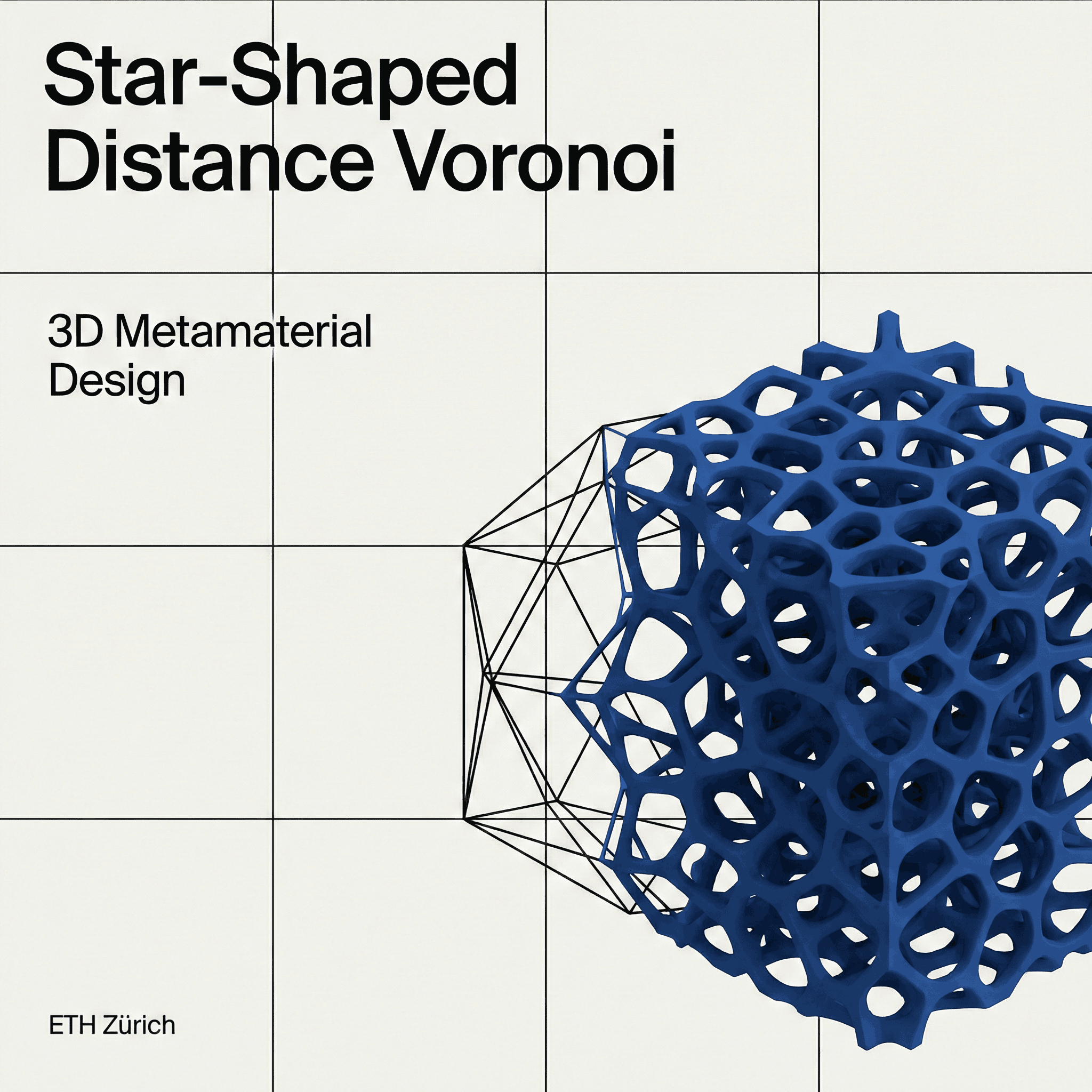
A recent paper from Logan Numerow, Stelian Coros, and Bernhard Thomaszewski at ETH Zürich proposes something closer to a grammar. Their work, "Star-Shaped Distance Voronoi Diagrams for 3D Metamaterial Design," extends a compelling 2D idea into the third dimension and, in doing so, constructs a continuous, differentiable parameterization over an extraordinarily broad space of cellular microstructures.
The Geometry of the Metric
The core idea is a quiet but powerful one: rather than defining a Voronoi diagram by Euclidean distance—the ordinary, isotropic notion of nearness—the authors allow the metric itself to become a design variable. The distance from any point to a Voronoi site is measured not by a circle (in 2D) or a sphere (in 3D), but by a custom geometric primitive called a metric polyhedron: a compact, star-shaped solid whose vertices and faces encode a particular notion of direction-dependent proximity. Deform the polyhedron, and you deform the cell.
This substitution sounds subtle; its consequences are anything but. By traversing the space of metric polyhedra—rotating their faces, extending their vertices, morphing their aspect ratios—designers gain continuous access to a sweeping range of cellular morphologies: closed-cell foams that range from near-spherical to aggressively faceted, lattices that resemble familiar TPMS forms, and entirely novel hybrids that sit between any of these extremes. The structure of the space is not a collection of islands. It is a connected continent. This stands in stark contrast to prior art. Combining, for instance, the topology of a gyroid with that of a diamond surface is an ill-defined problem, often requiring ad-hoc heuristics or volumetric blending that can compromise structural integrity. Here, the transition is not a blend but a true, geometrically valid path through the design space, ensuring that every point along the way corresponds to a well-formed, manufacturable structure.
"The geometry of each cell is not dictated by Euclidean distance, but by a custom metric defined by a 'metric polyhedron'—altering its vertices fluidly controls the resulting cell shape."
The authors' primary technical achievement lies in rendering this construction fully differentiable. Extending the algorithm from 2D to 3D is not a mere dimensionality upgrade; it requires navigating a substantially more complex landscape of vertex and edge cases, a problem the paper addresses with careful rigor. The intersections of two planes in 2D produce a point; in 3D, they produce a line. The intersection of three planes produces a single vertex. Each of these interactions—between the faces of metric polyhedra, between polyhedra and the bounding domain—represents a unique condition. The true challenge, solved by the authors, was to create a unified mathematical expression that could capture this combinatorial explosion of cases and, critically, provide a clean gradient through all of them. It is an act of meticulous geometric bookkeeping that underpins the entire inverse design pipeline. The result is a system where the geometry of the output structure is a smooth, differentiable function of the input parameters: the Voronoi site positions and the polyhedron vertices. And differentiability, in the contemporary design pipeline, is everything. It is the property that allows gradient-based optimization to run, and gradient-based optimization is what transforms a forward simulation into an inverse design tool.
To expand the space further, the team introduces a technique of selective interface exclusion—removing the faces that form between corresponding sites in a periodic tiling. The effect is to dissolve the closed-cell walls and produce open, porous structures that evoke TPMS and lattice forms, but without committing to any particular family. Porosity, connectivity, and cell openness become additional parameters available to the optimizer.
Inverting the Problem
The shift is a profound one. The designer is no longer a direct sculptor of form but a specifier of function. They articulate the desired performance—the objective function—and the optimization algorithm navigates the vast parameter space to find a corresponding geometry. It is a paradigm that elevates the design process from selecting patterns to defining principles, trusting the mathematics to translate abstract intent into physical reality. The demonstrations are a testament to the framework's reach. Given a target directional stiffness profile—say, a material that resists compression along one axis while remaining compliant in the others—the system finds the microstructure that achieves it. Given a target nonlinear stress-strain curve, with its particular yield point and post-yield softening, it computes the geometry. Given the requirement for strongly auxetic behavior—the counterintuitive property of transverse expansion under longitudinal stretch—it delivers a structure that expands as intended.
Perhaps most evocative is the demonstration of graded materials. Because the parameterization is continuous, the metric polyhedra can be spatially interpolated across a design domain. The result is not a stepped mosaic of different structure types but a seamless morphology: a material that transitions, without seam or discontinuity, from one mechanical character to another. This is the kind of result that a library-based approach cannot, in principle, produce.
The authors are measured about what remains. Physical validation is a necessary next step; the predictions of an optimization loop are only as trustworthy as the mechanical model they rest on. The space of possible structural representations—rod networks, spinodal decompositions—remains broader than what this single framework encompasses. But in replacing a catalog with a continuous, optimizable space, Numerow, Coros, and Thomaszewski have done something foundational. This foundation is one upon which more complex inquiries can be built. Could this geometric language be used to co-optimize for mechanical and thermal properties simultaneously? Can manufacturability constraints, such as minimum feature size or overhang angles, be encoded as penalties within the optimization? Moreover, such a parameterization provides a potent front-end for machine learning models, which excel at learning relationships within high-dimensional, continuous spaces. This work could provide the very language these future models will use to reason about, and ultimately create, the materials of tomorrow. They have offered the field of cellular metamaterial design not just new structures, but a new way of thinking about the structures that are possible.