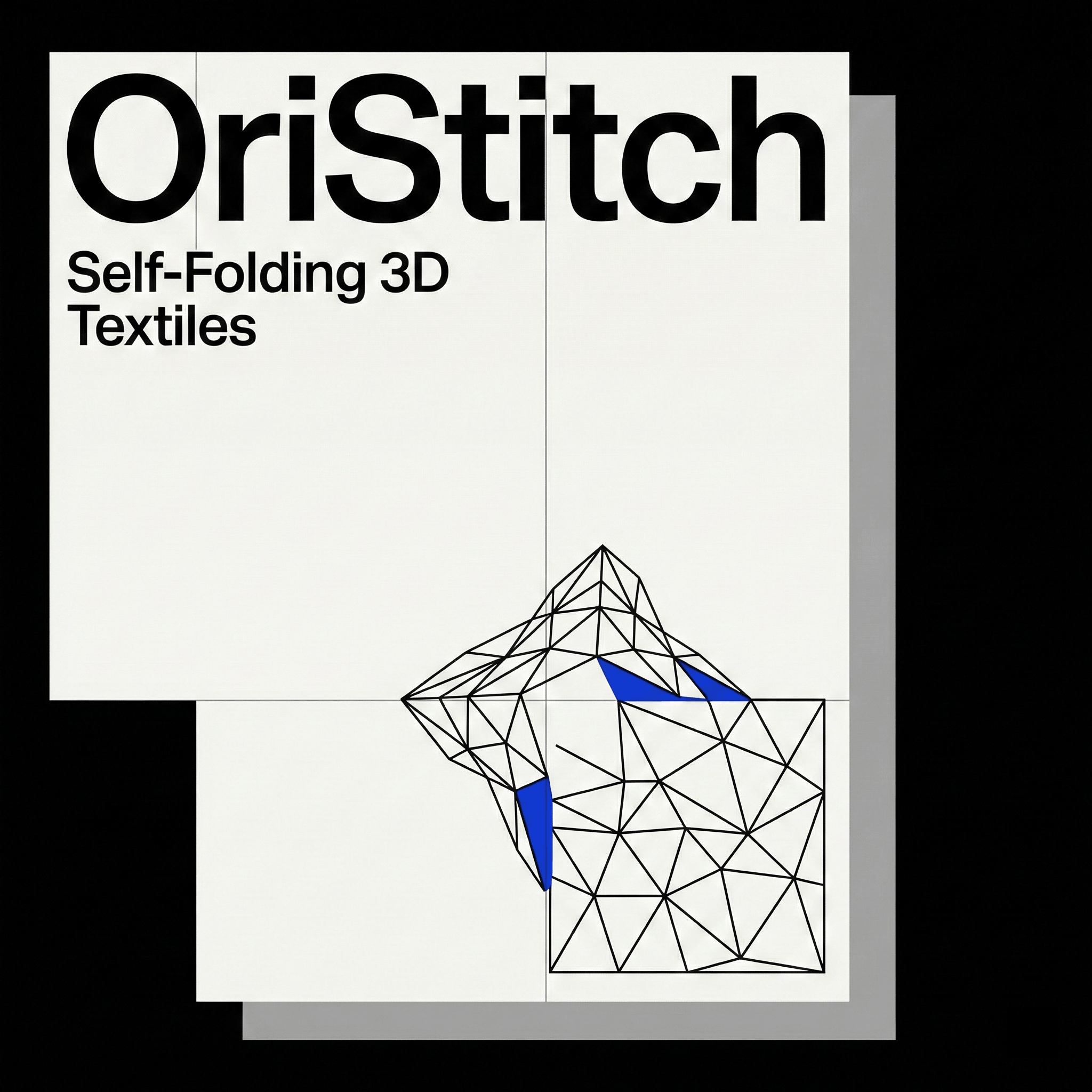
There is something almost alchemical about the process at its end: a flat piece of embroidered fabric, its patterns of thread seemingly decorative, is submerged in hot water and transformed. The water-soluble threads dissolve. The polyester threads—stitched in carefully calculated orientations—contract. The fabric creases, pulls, and folds into a three-dimensional form. What began as a flat textile has become a cap, a vase cover, a structured handbag. The machine that made it was a standard commercial embroidery unit. The material is ordinary fabric. The geometry was entirely encoded in the stitch pattern.
OriStitch, developed by researchers at Cornell University, the University of Toronto, and the University of Tokyo, is a computational design system that turns machine embroidery into a programmable folding platform. The premise addresses a real gap in the fabrication landscape: self-folding structures have been demonstrated across a range of material systems—shape-memory polymers, humidity-responsive bilayers, 4D-printed composites—but most require either specialized materials or esoteric fabrication equipment. Embroidery machines, by contrast, are widely available, well-understood, and capable of depositing thread patterns at high spatial resolution across diverse substrates.
Engineering the Hinge
The hinge is the fundamental unit of the system, and it is where the team's material intelligence is most concentrated. Each hinge is not a mechanical device but a programmed stitch pattern that combines four distinct thread types. An active polyester thread, which shrinks approximately 30 percent when heated, provides the actuation force. A water-soluble bobbin thread holds the active thread in a floating configuration during the embroidery process; it disappears in the activation bath, freeing the active thread to contract. Standard structural threads form channels that guide the active thread and lock points that anchor it to the substrate. A final zig-zag fold stitch, placed precisely along the intended crease line, predisposes the fabric to bend in the correct direction.
For narrow fold angles, a simple scored hinge suffices. As the geometric gap between adjacent panels grows—demanding that more excess material be tucked away to achieve the correct fold—the system escalates to more complex hinge types. The most architecturally ambitious is the "harmonica fold," which manages significant material volume through multiple nested shrinking paths, enabling the formation of highly curved surfaces from a single flat textile.
"The OriStitch system encodes geometry entirely in the stitch pattern—no specialized materials, no bespoke machinery. Fold angles, curvature, and panel alignment are all programmed before the needle begins."
The Computational Workflow
The software pipeline extends the existing Origamizer tool. Starting from a standard 3D mesh file, the system computes a 2D developable surface—an unfolded flat pattern—and then analyzes each fold line to select the appropriate hinge type based on the geometry of the gap it must close. A multi-hooping algorithm handles an important practical constraint: most designs exceed the working area of a single embroidery hoop. The system partitions the master stitch file into a sequence of overlapping jobs, carefully managing thread continuity at the boundaries so that no structural connections are severed between hoop reconfigurations.
The researchers validated the pipeline against 26 of 28 canonical origami models from the academic literature, confirming broad geometric coverage. Material tests across suede leather, neoprene, cork, and felt confirmed that the hinge behavior generalizes well beyond standard woven fabric, suggesting that the design space of applicable substrates is wide.
What OriStitch represents, finally, is a particular kind of democratization: not the radical kind that makes a new technology available overnight, but the quieter, more durable kind that brings computational geometry within reach of existing machines and materials. Embroidery has been a medium of pattern and decoration for millennia. It is now, provisionally, a medium of form.