Hold a peacock feather up to the light and tilt it slowly. The blue shifts, deepens, then flares into green. There is no dye responsible for this. No pigment was deposited, no chemistry applied. What you are witnessing is architecture operating at the scale of wavelengths: a nanostructure of melanin barbules, precisely spaced, whose interference with incoming light produces color through geometry alone. The peacock does not paint itself. It builds itself into visibility.
Structural coloration has captivated researchers for decades, but mastering it as a design medium has proved elusive. The challenge is not merely fabricating fine structures—lithography handles that—but computing the relationship between a surface geometry and its optical output with enough fidelity to run in reverse: to start with a desired visual effect and derive the required surface. A new paper from a team spanning KAUST, Zhejiang University, and KAIST now provides precisely this capability. Their work, "Designing and Fabricating Color BRDFs with Differentiable Wave Optics," presents a complete pipeline for programming the angular and spectral properties of reflected light into physical surfaces.
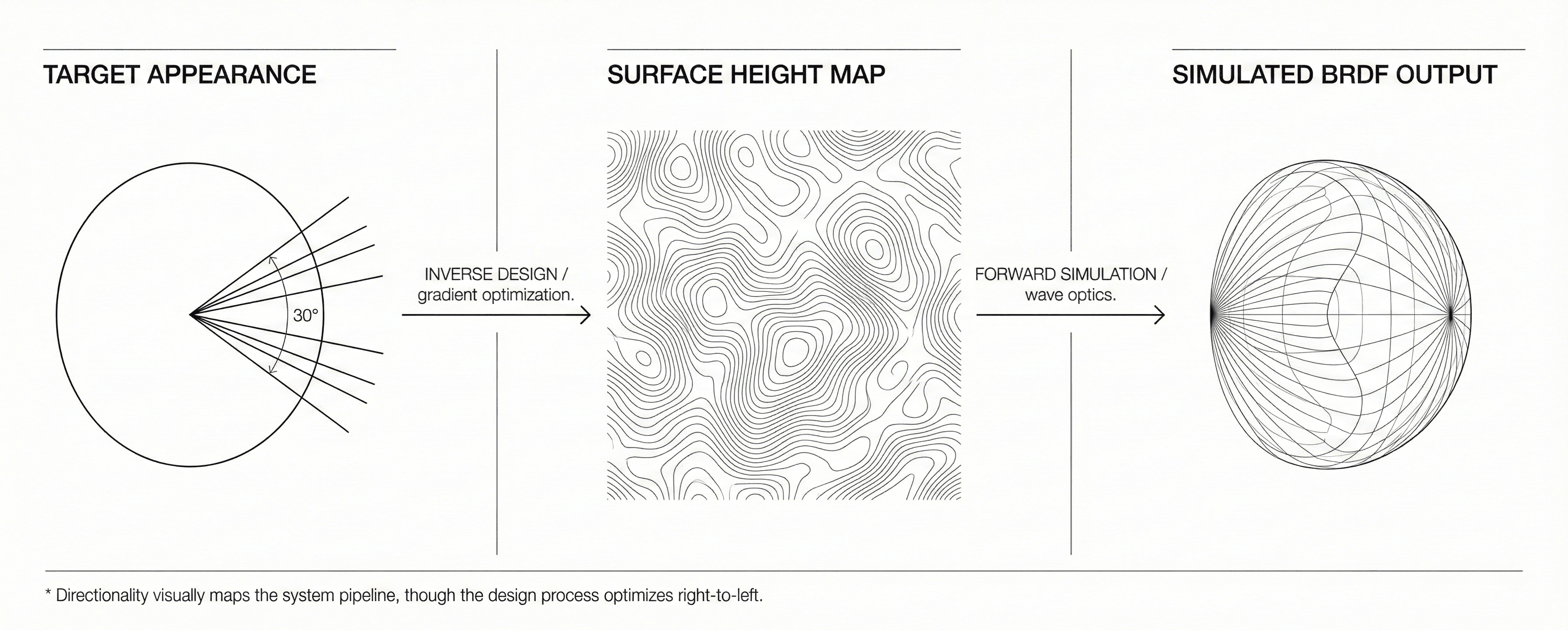
The key word in their framework is *differentiable*. Previous wave-optics approaches to surface design were typically forward-only: given a surface, compute what it looks like. This new system makes the entire optical simulation—from a surface height map through to the final rendered image—mathematically transparent to gradient-based optimization. The machine can now ask not just "how does this surface reflect light?" but "what surface produces this reflection?"
Decomposing the Wave Field
To make this computationally feasible at high resolution, the team employs a Gabor kernel decomposition to model wave interactions across the surface. This Gabor approach is critical because it treats the surface locally. Rather than attempting a brute-force calculation of every light wave interaction across the entire surface simultaneously—a task that would demand prohibitive memory—the model breaks the problem into a mosaic of overlapping, computationally manageable regions defined by the light source's own coherence. Within each local patch, interference is modeled with wave-optical rigor; between patches, intensities are summed incoherently. This mirrors the physics of real-world extended light sources and makes the inverse problem tractable. The output of the optimizer is a height map: a continuous topographic description of the surface at micrometer precision, ready for translation into physical reality via grayscale lithography on aluminum-coated silicon wafers.
"By starting with a target appearance—a red emblem visible only from a 30-degree angle—the system automatically computes the microscopic surface geometry required to produce it, learning the correct nanostructure by minimizing the gap between simulation and target."
The demonstrated applications are striking in their diversity and precision. The team fabricates anti-mirrors: surfaces engineered to suppress specular reflection, scattering light away from the expected bounce angle. These are not simply diffuse surfaces, but precisely calculated structures that create a null zone—an engineered absence of light where a bright reflection would normally be. They produce pictorial BRDFs—surfaces that render coherent images in reflected light, visible only from specific angles. They achieve iridescent multi-dot patterns whose color shifts predictably with viewing direction. In each case, a physical prototype shows remarkable correspondence with its simulated counterpart, a result that speaks well of the framework's capacity to bridge the notorious gap between digital model and fabricated object.
The Matter of Color, Without Color
The implications radiate in several directions at once. For product design and luxury goods, structural coloration offers surfaces of unusual depth and dynamism—colors that are not printed but woven into the material's geometry. This last property is of obvious value for security applications. A structurally colored security feature is not an image to be scanned and reprinted; it is a physical function. Its authenticity is tied to the nanometer-scale precision of its topography, a feat of manufacturing far beyond the reach of conventional forgery. Replicating it would require not a high-resolution printer, but a fabrication facility of equal sophistication, guaranteeing a uniquely robust defense against counterfeiting.
There is also an environmental dimension that deserves attention. Conventional dyes and pigments are a significant source of industrial pollution; the textile industry alone accounts for a substantial fraction of global water contamination. A fabrication process whose color effects require no chemical input at all—only geometry and light—points toward a materially lighter way of making things visible.
None of this is to suggest that grayscale lithography on silicon will soon replace inkjet printing in most contexts. The process is still constrained in substrate and scale. Furthermore, the framework itself is extensible. While the current model assumes a globally planar surface and neglects complex effects like shadowing, it provides a robust foundation upon which more physically complete simulations could be built. This is the first step toward a more general-purpose computational physics of appearance. The paper's most lasting contribution may be less about the specific applications it demonstrates than about the framework it establishes: a differentiable, manufacturable link between optical intent and surface geometry, opening the door to a design practice where light itself is a programmable material.