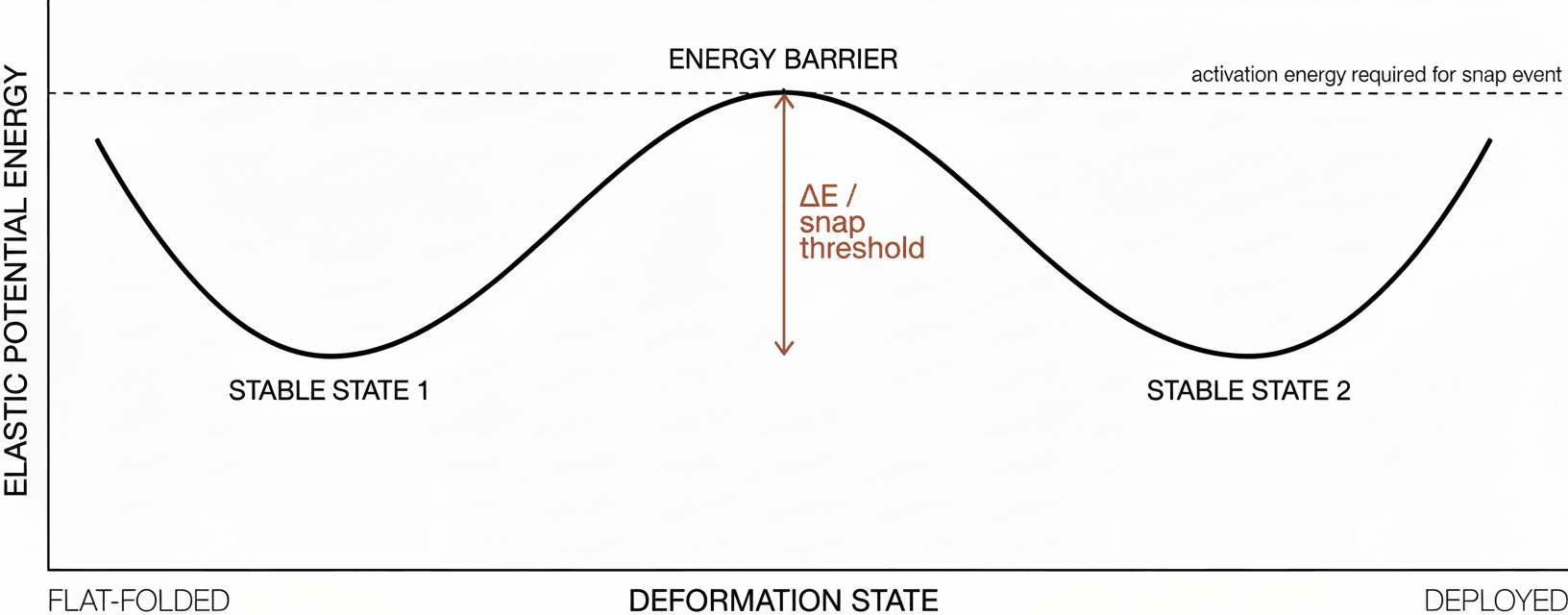
The snap is not a failure. It is a feature. When a bistable shell passes through its unstable intermediate configuration and clicks into its second stable state, the energy stored in its elastic deformation is released in a sudden, controlled event—a mechanical logic embedded in the geometry of the structure itself.
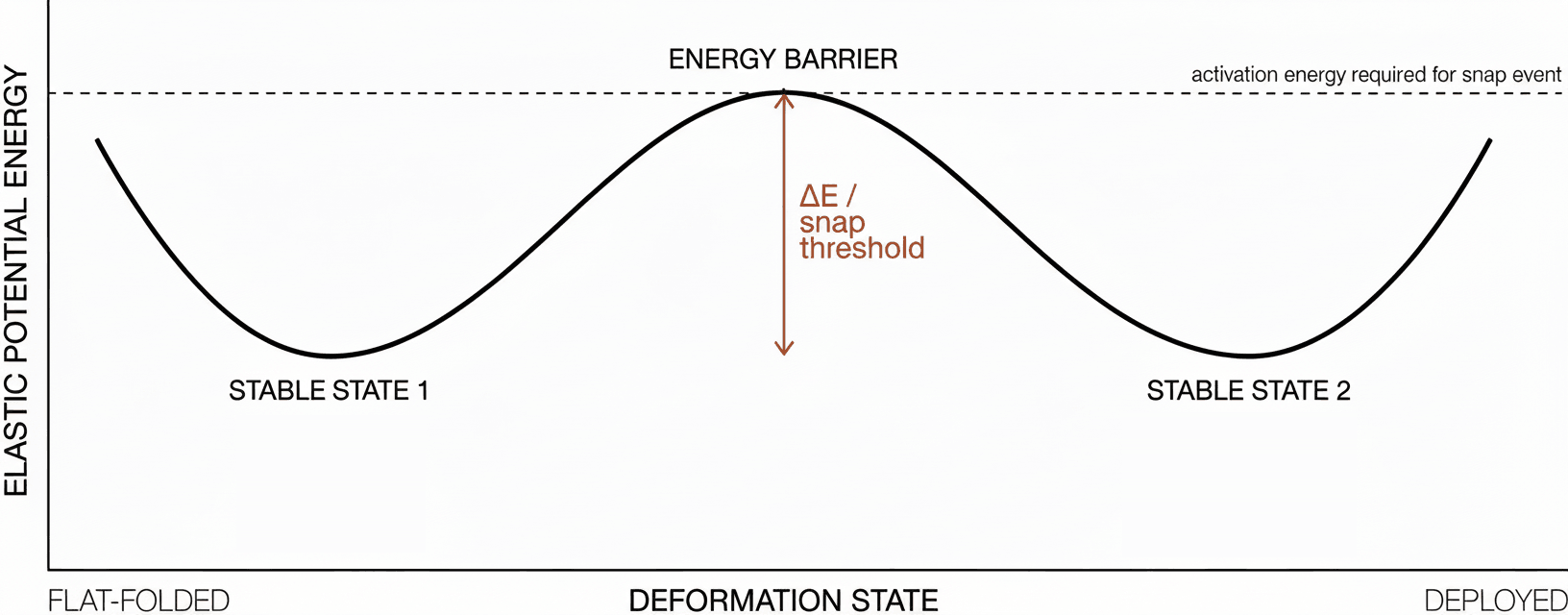
This bistability is the animating principle behind a recent paper in ACM Transactions on Graphics by Felix Dellinger, Martin Kilian, and collaborators at TU Wien and the University of Tokyo. Their work introduces PQ-toroids—a new class of polyhedral modules that snap between a perfectly flat-folded compact state and a volumetric deployed state, and can be assembled into freeform doubly-curved gridshells without any external locking mechanism.
The intellectual lineage is worth naming. Previous work on deployable toroids (T-toroids) had demonstrated the bistable snap in modules limited to convex, positively-curved surfaces. PQ-toroids generalize the geometry substantially. Each module is constructed on an arbitrary planar quadrilateral base, with side faces defined by coplanar adjacent offset directions. This expansion of the geometric foundation enables the assembled modules to conform to surfaces of any curvature sign—including saddle-shaped anticlastic regions that the predecessor system could not address.
From Module to Manifold
The design pipeline navigates from global intent to local detail with care. A target freeform surface is first approximated by a Q-net—a mesh of planar quadrilateral faces—through an optimization that simultaneously enforces planarity, surface fairness, and alignment with principal curvature directions. Each face of this mesh then becomes the base of a unique PQ-toroid. The module's geometry is further specified by two additional fold lines, placed to resolve a subtle topological incompatibility: without them, the closed toroidal loop cannot fold flat.
"We introduce a novel class of polyhedral tori, PQ-toroids, that snap between two stable configurations: a flat state and a deployed one separated by an energy barrier—no locking mechanism required."
Assessing whether each module will actually snap—whether its energy barrier is physically meaningful—requires simulation at multiple levels of fidelity. For design iteration, the team proposes a lightweight "incompatibility method" that estimates the snapping barrier by measuring geometric mismatch between the two halves of a toroid during its hypothetical folding motion. This provides rapid feedback without expensive simulation. For detailed analysis, a "quad soup" model treats the module as rigid panels connected by elastic hinges, capturing the mechanics of panel bending in the snap event. Full FEA validation confirms the results and surfaces nuances, such as localized panel crumpling under certain geometric conditions, that the simplified models cannot see.
A Desktop Demonstration
The physical realization is a desktop-scale model: sixty unique PQ-toroids, each laser-cut from flat sheet, assembled into a complex doubly-curved surface. Each module independently snaps between its two states; the assembled surface can be selectively reconfigured, deployed, or folded by manipulating individual modules. The model is not just a proof of concept but a demonstration of a logistical proposition: the entire shell can be transported in its flat-folded state and assembled on-site by expansion alone.
By grounding a mechanically sophisticated bistable system in the rigorous language of discrete differential geometry—Q-nets, conjugate nets, discrete hyperbolic line congruences—Dellinger and colleagues have built something more durable than a novel module. They have built a theoretical and computational foundation for a class of deployable structures whose complexity is geometrically controlled rather than mechanically imposed. In an architectural culture increasingly interested in lightness, mobility, and reconfigurability, that foundation is well-timed.