Numerical computation is always an approximation. The coordinates of a root of a polynomial, computed by a homotopy continuation solver, live inside a small but non-zero ball of uncertainty. They are known to within $\varepsilon$, not exactly. This is not a failure—it is the condition of almost all practically relevant geometric computation. The question is whether the mathematical structures we build on top of those coordinates are robust to the uncertainty within which they sit.
For many quantities, the answer is yes. Distances, angles, convex hulls: all degrade gracefully as coordinate precision degrades. But for topological invariants—properties that are, by definition, either true or false with no continuous middle ground—the situation is more treacherous. The lexicographic ordering of two points, which determines how a braid word is read, flips categorically when the real parts of their coordinates are equal. A tiny numerical perturbation in that imaginary borderland does not produce a slightly wrong braid word. It produces a *categorically* wrong one.
This fragility is the starting point for a recent paper by Alexandre Guillemot and Pierre Lairez, *Computing Braids from Approximate Data*. Their work constructs an algorithm for computing braids from paths defined by numerical approximation—one that is stable by design rather than by hope.
From Coordinates to Separation
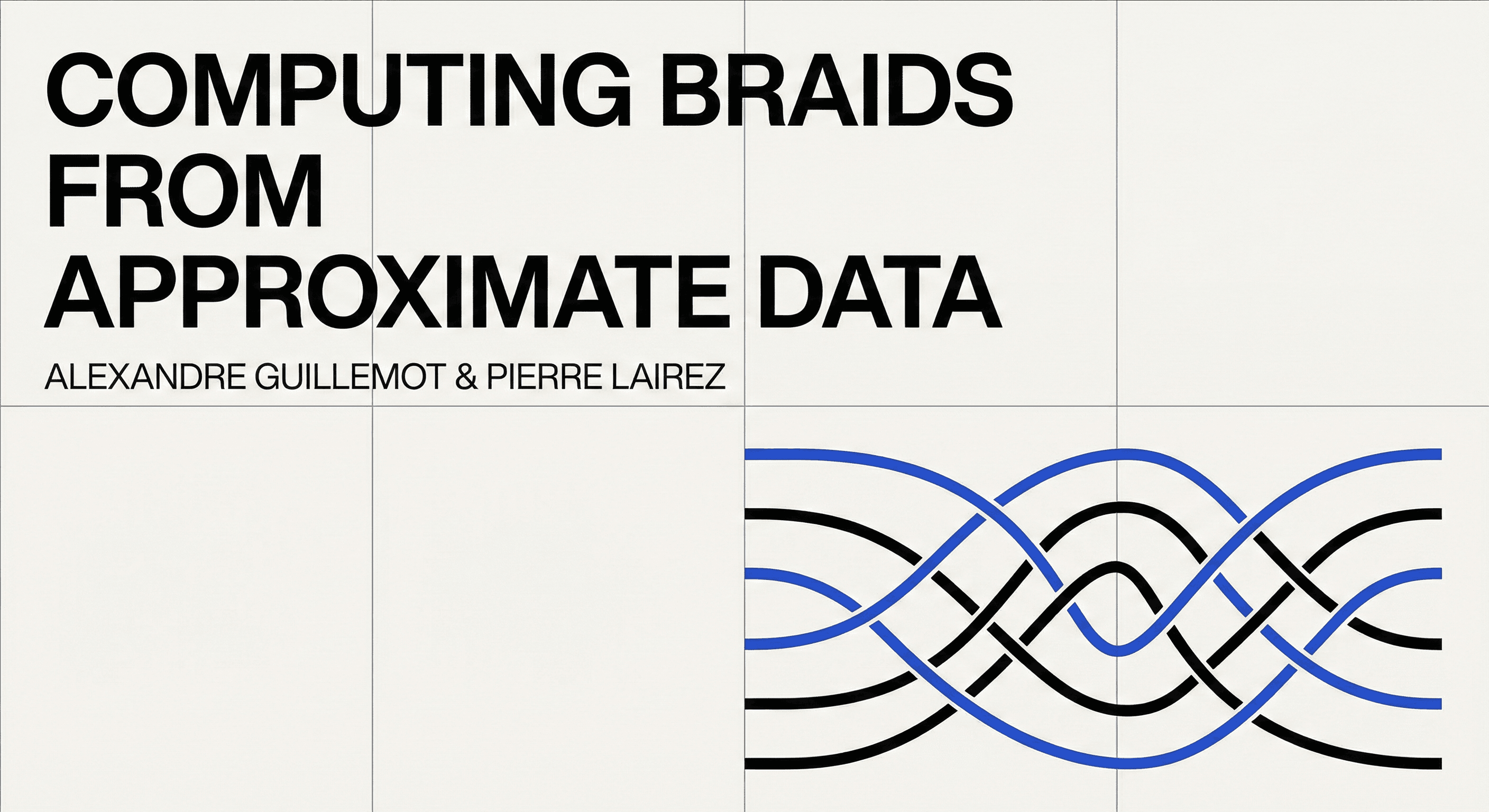
Geometric braids arise naturally when $n$ points move through the complex plane without colliding. The trajectory they trace—technically, a path in the configuration space $\mathrm{Conf}_n(\mathbb{C})$—can be encoded as a word in the braid group, first formalized by Emil Artin in 1947. In the context of computational algebra, these paths often arise from tracking roots of a parameterized polynomial through a continuous deformation. The braid word records the topological entanglement of those roots: which one passed over which, and when.
The problem is that traditional exact algorithms read the braid by sorting points lexicographically at each timestep—and lexicographic sorting is precisely the operation that catastrophically fails under numerical approximation. Guillemot and Lairez resolve this by moving away from the question "where is each point?" to the question "can these two points be separated along a given axis?" This *separation predicate* is inherently robust: it depends not on the absolute value of a coordinate but on whether an interval of uncertainty admits a strict ordering, a question that interval arithmetic can answer reliably.
"Rather than asking where a point is, the algorithm asks whether two points can be separated along a specific axis. This shift—from position to relation—makes the computation robust to the approximate data that certified numerical methods actually produce."
Arrangements as Combinatorial Abstractions
The algorithmic innovation lives in the formalization of "arrangements"—data structures that represent the relative positions of points as strict partial orders rather than coordinate tuples. By encoding the configuration as a combinatorial object in the topology of a CW-complex, the authors provide a framework where the homotopy type of a path can be recovered without requiring an exact piecewise linear representation. Previous methods required a linearization step—approximating curved paths within their uncertainty tubes by straight segments—which becomes increasingly expensive as tube radii decrease. The Guillemot-Lairez approach avoids this step entirely.
The algorithm, named *braid'*, initializes a graph of point relations from separation predicate queries and updates it incrementally as the path evolves. A "pointed arrangement" data structure pairs the partial order with a valid permutation point, maintaining consistency as the system traverses the trajectory and adding new separation constraints only as they become relevant.
The Rust implementation stands as both a theoretical proof and a practical contribution—connecting the certified outputs of modern homotopy continuation solvers directly to exact topological results. It is an argument, made in code, for a principle that is easy to state but surprisingly difficult to act on: that the most robust algorithms are not those that fight the uncertainty in their inputs, but those that acknowledge it as a first-class property of the data they process.